- Unlike regions with independent power grids, power in the Southern states is provided by integrated power companies. Each of these companies is linked to nearby grids and power can be traded between them. However, because these are still regulated markets, there is little opportunity to trade power within the service area of any of these companies.
- The Gulf Coast region is characterized by mild winters and prolonged hot summers. Long-lasting heat waves can start affecting the area inearly spring and may last until late October ==> Seasonal demand is quite different from the northern states --- demand is low most of the winter and peaks for an extended time in the Summer.
- From a precipitation perspective, the southeastern United States has a tropic climate.
- There is a wet season running from November to May, and a dry season running from June to October.
- There is substantial hydroelectrical generation in the Tennessee Valley area that is affected by this rainfall. During the period of high rainfall, the Tennessee Valley can export power to other parts of the Southeast, the Midwest, or the East Coast.
- Coal and natural gas are both marginal fuels for the area. There are ready supplies of both fuels locally --- the Gulf Coast is a major source of natural gas, and the Appalachian Mountains contain abundant coal deposits.
Important Notice !!!
This blog has been discarded and no update any more.
Please visit http://www.quantlego.com for active updates.
Sorry for any inconvenience.
Please visit http://www.quantlego.com for active updates.
Sorry for any inconvenience.
Showing posts with label Electricity. Show all posts
Monday, June 17, 2013
Southeast and Gulf Coast electricity markets
New England electricity market (ISO-NE)
- There is only a single trading hub in the New England region. The price at thsi hub are based on selected nodes around the Boston area.
- New England has to import fuel for almost all of its power generation requirements.
- The marginal fuel for the region is natural gas. The bulk of this supply comes from the U.S. Gulf Coast and eastern Canada.
- There are efforts to augment this supply by constructing liquefied natural gas terminals in Massachusetts.
- Most of the population in New England is in the southern part of the region: Connecticut and the area around the city of Boston, Massachusetts. In contrast, the northern part of the region is relatively unpopulated.
New York electricity market (NYISO)
- The New York power grid is self-contained in the state of New York.
- The southeastern part of this region the most heavily concentrated areas of demand for electricity in the country: New York City and Long Island.
- The region is characterized by the flow of low cost power from the northern and western sections of the state into the high demand regions surrounding New York City.
- Most of New York metropolitan area is located on islands ==> (1) there is limited ability to transfer power to those areas from other parts of the region; (2) high reliance on inefficient generators during periods of peak demand. ==> New York City area is one of the most expensive power market in the country.
- To assure reliable service, power plants in the New York metropolitan area are subject to much stricter rules and regulatory requirements than are common in other regions.
Midwest electricity market (MISO)
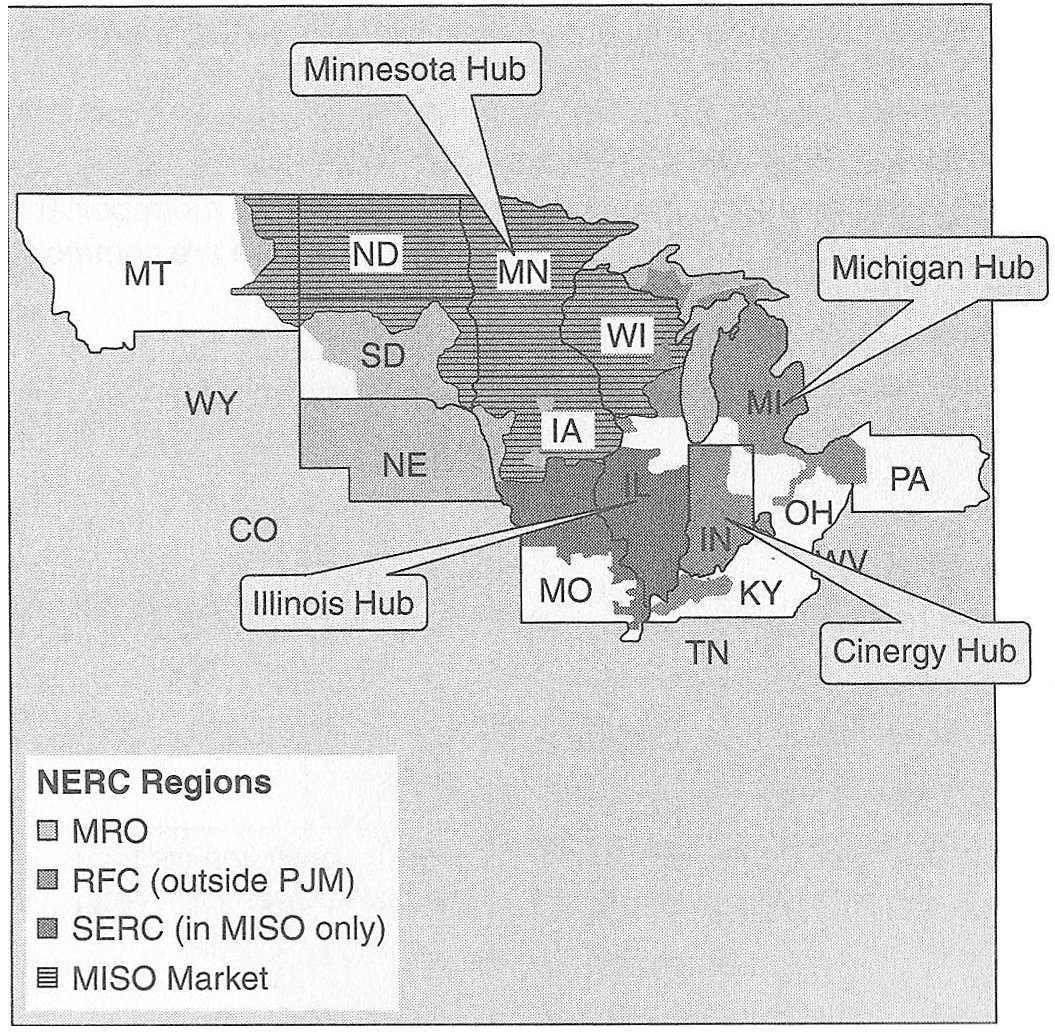
- The Midwest ISO coordinates power for the north-central United States
- The eastern part of the MISO region is heavily industrialized.
- The western section of th MISO region is more rural.
- There are several major trading locations in the region. among them Cinergy Hub is the most influential.
- From a climate perspective:
- The middle of the United States has cold winters and hot summers.
- The cold weather usually starts in December, but can arrive in early November and usually lasts through April.
- The summer months, July and August, are hot and humid, but the weather cools off quickly in September.
- Many of the power plants in the region, including a large number of marginal producers, are coal powered ==> Coal prices often dominate the price of power in the Midwest even in high demand periods. This is a unique feature of the area (In most of United States, the power price is set by natural-gas-fired plants).
- Power is often wheeled from the Midwest to adjacent regions when the price of natural gas spikes upward.
- Cool shoulder months (the spring and fall) in the Midwest ==> Power is often wheeled to southern states where hot weather is more common.
- Some hydroelectric power is available from the Great Lakes and Tennessee Valley areas. Depending on the time of the year, power may be imported from either of these two regions.
Mid-Atlantic electricity market (PJM ISO)
- The Mid-Atlantic region contains many large population centers, like Washington D.C., Baltimore, and Philadelphia, on the eastern seaboard.
- This area formed one of the first independent power grids, the PJM ISO, named after its condtituent states: Pennsylvania, New Jersey, and Maryland.PJM has since expanded to include West Virginia, Delaware, large parts of Ohio, parts on northern Illinois, and Virginia.
- It is one the largest and most liquid electricity markets. A number of active trading hubs are located within PJM.
- Geographically, the PJM service area is very diverse:
- Large reserves of coal native to Pennsylvania and West Virginia serve as the marginal fuel for western part of the PJM service area.
- Power on the East Coast and Virginia is commonly determined by gas-fired power plants.
- Climate:
- The climate in the northern half of the region ranges from cold winters to hot summers.
- The climate in the southern half of the region is warmer --- mild winters and extended hot summers.
- A large number of power plants in the less populated areas of the PJM service area export power into the more populated regions ==> the power lines between these areas are often congested.
Pacific northwest electricity market
- In most years, the Pacific Northwest sells surplus power into California and the Southwest.
- About two-thirds of all the electricity in this region comes from hydroelectric production ==> the quantity of surplus power depends heavily on precipitation ==> Water flow in this region directly affects the price of power in California.
- Melting snow from the Cascade Mountain range, which runs through central Washington and Oregon, is a major source of river water.
- To the west of the mountains are several major population centers: Seatle, Washington, and Portland, Oregon. The climate in these regions is fairly temperate all year.
- To the east of the mountains is the start of the northern plains state. This area is characterized by cold winters and hot summers.
- Mid Columbia (MIDC): is a delivery hub for a number of hydroelectric plants on the Columbia River.
- California-Oregon Border (COB): is a major switching station in southern Oregon, adjacent to the California border, that interconnects several major transmission lines.
Desert southwest electricity market
- The desert southwest has moderate winter and prolonged hot summers
- Mush of the year, the area has a surplus of generation capacity and is a major exporter of power to South California.
- Natural gas is the most common marginal fuel due to the abundant natural gas reserves, but coal and hydropower are relatively common too.
- The area also receives a great deal of sunlight, making it an attractive location for solar power.
- There are three major hubs for electricity trading in the area, and major power generation facilities are located near each hub.
- Mead: is located on the outskirts of Las Vegas. Lake Mead is the artificial lake formed when the Hoover Dam was built on the Colorado River. The Hoover Dam is a major source of hydroelectric power and the primary delivery point for power in southern Nevada.
- Palo Verde: is located at a major nuclear power plant and switching yard about 45 miles west of Phoenix, Arizona. Many high power lines to California are located at this switching yard.
- Four Corners: is located in northwestern New Mexico at the interconnection of several major transmission lines.
California electricity market (CAISO)
- California is a heavily populated state that is divided into two major zones: NP-15 and SP-15.
- Most of the year, the daily temperatures are moderate to warm. However, the dense population and hot summers can cause spikes in the electrical loads due to a demand for air conditioning.
- One of the major transmission lines, Path-15, bisects the state into two approximately equal parts and has given its name to the two major zones: NP-15 and SP-15.
- NP-15 (North Path 15)
- Covers the northern part of the state (San Francisco Bay area), north of Path 15.
- When rainfall or melting snow allows, this region imports low cost electricity from the Columbia River Basin in Oregon.
- For the remainder of the year, natural gas plants, supplied primarily from western Canada, set the price of power in NP-15.
- SP-15 (South Path 15)
- South of Path 15, the pricing zone for most of Southern California.
- A major importer of power from Arizona (natural gas and solar power) and Nevada (hydropower from the Colorado River).
- Natural-gas-fired plants in the south are fed from supplies in the rocky Mountain and West Texas regions.
- ZP-26
- A large but less important pricing zone that has a relatively low population and excess generation capacity.
- It connects to both the NP-15 and SP-15 zones.
Monday, May 13, 2013
Regional power markets in United States
There are three major integrated power grids in the United States:
Electrical prices vary regionally with an interconnection depending on regional population, industries, and weather conditions ==> Long distance transmission of power, called wheeling, between fundamentally different markets is the source of large number of trading opportunities.
Texas Interconnect
Read More
- Eastern Interconnect --- east of the Rocky Mountains
- Western Interconnect --- west of the Rocky Mountains
- Texas Interconnect --- Texas
Electrical prices vary regionally with an interconnection depending on regional population, industries, and weather conditions ==> Long distance transmission of power, called wheeling, between fundamentally different markets is the source of large number of trading opportunities.
Texas Interconnect
- Smallest interconnection in the United States.
- Entirely located within the state of Texas.
- Coordinated by a single ISO, the Electric Reliability Council of Texas (ERCOT).
- There are a number of DC power lines, of limited capacity, connecting the Texas power grid to the Eastern Interconnect and the Mexican power grids.
- The West Interconnect is a long line of regional grids stretching from the Pacific Northwest into the Desert Southwest, with California in the middle ==> Much of the trading in the Western Interconnect revolves around the flow of power into or out of the highly populated areas of California.
- The pacific Northwest (MIDC) and Colorado River (Mead) near las Vegas are major sources of hydroelectric power.
- 70% power supplies in Washington and Oregon come from hydroelectricity ==> small changes in water flow can result in substantial changes to regional power supply ==> Snow melts during Spring lead to more power supply than demand in Pacific Northwest, so some power is transmitted to areas of higher demand (usually California).
- California is a densely populated area: in summer it needs import of power from Pacific Northwest and Desert Southwest; in Fall mild temperature makes it possible to export power to still very hot areas of Las Vegas and Phoenix.
- The marginal power producers in California are usually natural-gas-fired plants ==> a steady supply of natural gas is required: southern California imports natural gas from the Rocky Mountains and West Texas, and northern California import natural gas from west Canada.
- It includes the two most important RTO/ISOs: PJM (originally named the Pensylvania, New jersey, and Maryland Interconnection) and MISO (Midwest ISO)
- The two most liquid trading locations in the Eastern Interconnect are Cinergy Hub (abbreviated MISO-Cin Hub) and PJM Western hub (PJM-W).
- Varieties in fuels and regional weather conditions provide many trading opportunities in the East Interconnect:
- Some important trades are between regions using col-fired plants and those using natural-gas-fired plants
- Other trades are weather related.
- The southern part of Eastern Interconnect has extended summer and mild winter, while the northern part has colder winter and shorter summer air-conditioning season.
Sunday, May 12, 2013
Heat rate and spark spreads
Heat rates
Read More
- Heat rate represent the efficiency of a power plant to convert fuel into electricity ==> Lower heat rate implies a more efficient power plant. \[\text{Heat Rate}=\frac{\text{Quantity of fuel used}}{\text{Quantity of power produced}}\]
- The unit of heat rate is Btu/KWh or MMBtu/MWh, with 1 MMBtu/MWh = 1000 Btu/KWh
- For example, heat rate of 8 MMBtu/MWh means a natural-gas-fired power plant will sell power profitably when the power price is 8 times of the natural gas price
- Market implied heat rate \[\text{Market implied heat rate}=\frac{\text{Power price}}{\text{Fuel price}}\] with the unit also being Btu/KWh or MMBtu/MWh.
- As a rule of thumb, natural gas power plants commonly have heat rates between 7 ~ 10 MMBtu/MWh.
- Heat rate extremely efficient
- Heat rate > 10 MMBtu/MWh ==> less efficient
- Spark spread is the theoretical profit that a natural-gas-fired power plant can make from buying fuel and selling power at current market prices, ignoring any charges for operational cost.
- Below tables shows an example of heat rates and spark spreads that are used by traders to approximate the behavior of electricity generators.
- Note: for coal-burning power generator, the corresponding spread is called dark spread.
Spark Spread = Power Price - (Gas Price × Heat Rate)
Design of electrical trading markets
Spot vs forward power markets
Read More
- The forward power market is where the bulk of speculative tradings occur, while the spot power market is where daily auctions occur.
- The forward market is open to anyone with sufficient money to meet trading requirements, while the spot market is open only to power providers with the ability to generate power and place it to the transmission grid.
- In forward market both physical contracts (requiring delivery of power) and financial contracts (settle in cash) are traded, while spot market involves only physical contracts.
- In spot market it is possible to buy spot power in arbitrary small sizes for immediate use anywhere in the country, while in the forward market it is only possible to trade large (month) blocks at a limited number (~20) of locations around the country.
- Trading power in large units at a limited number of locations has two consequences:
- Pro: it is easier to standardize contracts and find trading partners
- Con: trading prices at extended geographic areas around a major hub may not represent the exact price of power anywhere in the region ==> Power is often traded in two pieces: (1) standardized forward trades made at major hub to get the desired regional exposure approximately correct; (2) smaller fine-tuning trades to lock in an exact price at the specific location.
- Congestion charge: In periods of heavy demand, power lines can become overloaded ==> The primary way of rerouting power around congestion is to activate power plants close to the area of high demand even though their costs may not be low enough to enter winning bids of auction (out-of-merit-bid) ==> Under the FERC's Standard Market Design (SMD), the cost line congestion are paid by the affected parties (in a single location), rather than being shared by every user of the entire grid. Congestion costs aren't just paid by consumers, power producers pay them too. There is a charge for routing power into a high load area over congested power line, and a credit for producing power that bypasses the congestion.
- Line loss charge: Under the FERC's SMD, power produced only get paid for deliverable power, not on the gross power placed into a power grid.
- Locational Marginal Price (LMP) = clearing price (same everywhere in a power grid) + congestion charge (location specific) + Line loss charge (location specific) ==> Different prices are assigned to different locations in a power grid ==> location has become a major factor determining the profitability of a power plant, in addition to fuel cost and efficiency ==> There is economic incentive for power producers to relieve both line loss in transmission and line congestion ==> Power grid reliability increased significantly (compared with unregulated markets).
- There are three types of locations for calculating prices under SMD:
- Node prices: corresponds directly to the power price at an 'electrical bus', where power enters or leaves the transmission grid. Power generators are paid the nodal price of the electrical bus where they deliver power into the transmission grid.
- Zone price: is the average of all nodal prices within a limited geographical area. This is the price that customers pay for the power they receive.
- Hub price: is an average of selected nodal prices across several zones, and it serves as the benchmark price for a power grid ==> Hub prices are used extensively in forward market tradings. In most ISO/RTO regions, the clearing price for power and the hub price are synonymous.
- Financial Transmission Right (FTR)
- Here is a nice introduction about FTR.
- FTR is a financial instrument closely linked to Locational Marginal Price (LMP). It helps customers manage the price risk of having purchased or sold power at a major hub and then being forced to pay a different price when they deliver or receive power at a specific node.
- FTRs are tradable contracts made between two parties, which take opposite sides of an obligation to pay or receive the difference in price between two nodes. One party need to pay the other when there is a congestion.
- Sometimes FTRs can be structured as options, acting as insurance against adverse price change due to congestion.
- Trading products of power in terms of hours: weekdays x hours
- Peak: daytime hours, 7 am ~ 11 pm, examples are 5x16, 7x16
- Off-peak: nighttime hours, 11 pm ~ 7 am, examples are 5x8, 7x8
Overview of electricity markets
- It is hard to store electricity and expensive to transmit electricity over long distance ==> No unified national electricity market, instead just a collection of small regional markets with their own unique characteristics and regulations.In each market, supply and demand must constantly be matched, resulting in highly volatile prices.
- Regulations of regional markets
- Each regional is coordinated by its own Transmission Service Operator(TSO).
- In regulated markets, TSOs are government-sponsored monopolies
- In deregulated markets, TSOs are either Independent Service Operators (ISOs) or Regional Transmission Organizations (RTOs)
- ISOs are limited to doing services in a single state and are exempt from federal jurisdiction.
- RTOs are do business across several states and fall under federal jurisdiction.
- Some RTOs began in a single state as ISOs and became RTOs when they expanded across state boundaries, but they still keep ISO as part of their names.
- Deregulated markets use economic incentives to effect changes, while regulated markets use legislative mandates.
- In deregulated markets, the power price for a transmission grid is set by daily auctions
- Power producers submit the price at which they are willing to supply power, and are activated in order from the lowest to highest bid.
- All winning bidders get paid the same price regardless of their bids ==> non-discriminatory auctions
- The power price for every producer and every wholesale consumer is set to a single price ==> clearing price or wholesale price.
- Smaller customers pay a slightly higher power price ==> retail price
- The cost of bringing the last unit of electricity into the market is called the marginal price, and the most recently activated plant is the marginal producer ==> In deregulated markets, the clearing price is set by the marginal price of power.
- ISOs coordinate two types of auctions
- Day-ahead auction (DA)
- sets the power price for the following day in one-hour increments
- commonly completed in the early afternoon on the day before delivery ==> allows power producers have sufficient time to arrange fuel and operating schedules for the delivery day
- this auction is based on a prediction of next days' demands
- Real-time auction (RT)
- runs continuously throughout the actual delivery day
- balances the actual demand against the prediction of demand made in the previous day
- typically bid in five-minute increments
- Power plants participating in real-time auctions must have the capability of turning on and off quickly
Subscribe to:
Posts (Atom)
Powered by Blogger.